Lac des Ilettes à Sallanches - course d'orientation entre lac et rivière
Sallanches · near Passy
Which plan?
New plan
Added to your plan
This activity is part of “ ”. There are step(s) left.
will appear in your favourites and will be boosted. You can sign in to keep your favourites beyond this browser.
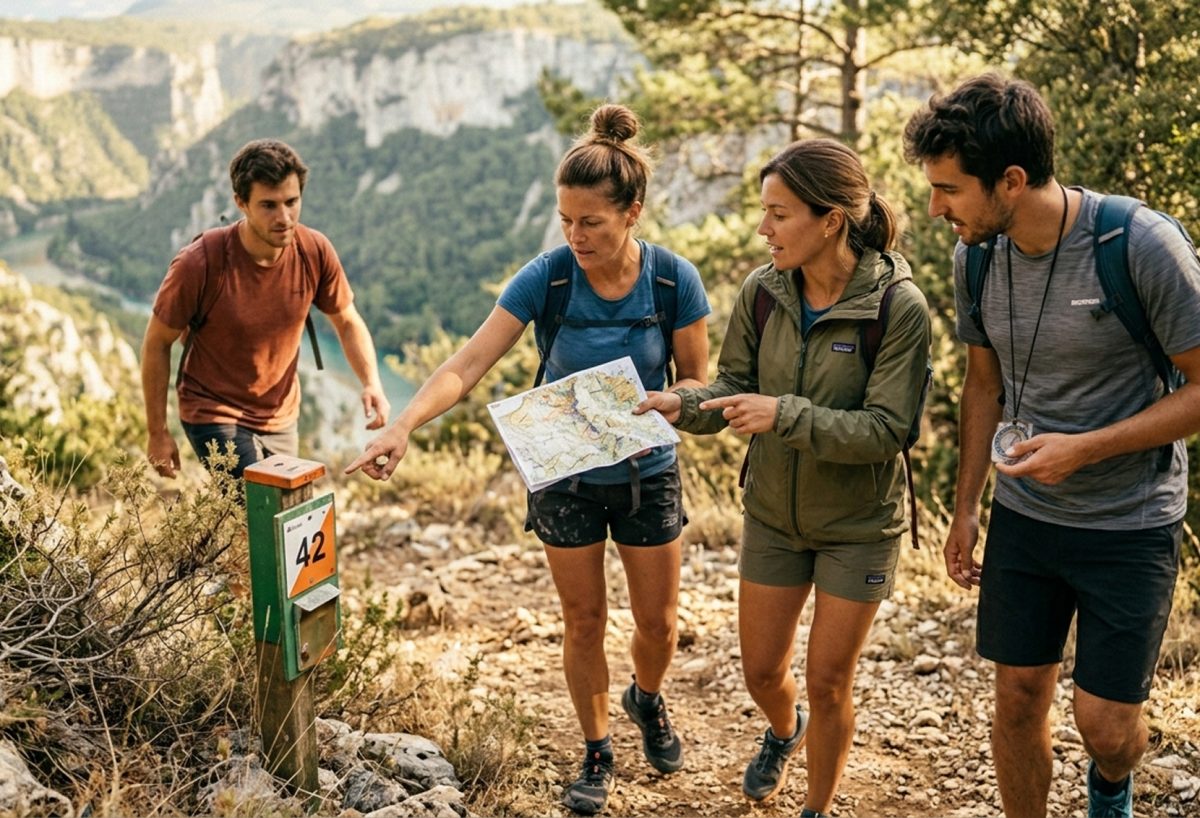
Speed helps only if you know where to go. Orienteering involves navigating between marked checkpoints using a standardised map and, if needed, a compass. It differs from a treasure hunt, where riddles usually reveal the next step.
Sallanches · near Passy
This activity is part of “ ”. There are step(s) left.
La Geneytouse · near Saint-Léonard-de-Noblat
Collias · near Nîmes
GPS treasure hunts and orienteering around the Gardon: a family route from age 8, from €25 per GPS in 2026.
Saint-Lyphard · near Saint-Nazaire
Know a spot?
A place missing here? Suggest it and we will check it before publishing.
Checked on
In orienteering, the orienteering map directly shows the terrain and checkpoints to find. The challenge is to choose and follow a route, not solve a narrative riddle. French federation FFCO describes foot orienteering as independently finding controls, often in a set order, using a map and compass. Treasure hunts may use clues or a story without requiring such detailed map-reading.
Orienteering maps use international IOF symbols for vegetation, landforms, obstacles and passability in fine detail. The FFCO gives scales from around 1:2,000 to 1:20,000, with forest competitions often using 1:10,000 or 1:15,000. The symbols and colours help you decide whether a detour is faster than the direct route.
Each checkpoint has an identifiable marker. The FFCO provides for electronic timing chips or physical punches on a card or map: each visit must leave a verifiable trace at the finish. On a beginner route, this makes the sequence measurable. Finding roughly the right location is not enough if the code or punch is wrong.
No. The classic course visits controls in a fixed order, but score orienteering involves visiting as many as possible, or collecting points, within a time limit. The FFCO documents both formats. A fixed course rewards efficient navigation between controls; score events also demand decisions about each control's value and the return time.
No. The FFCO confirms that orienteering can be practised at walking pace, including in Espaces Loisirs Orientation where an easy route often takes one to one-and-a-half hours on foot. The defining skill is navigating between controls with a special map. Competition adds speed, but a beginner can practise map-reading, bearings and route choice without racing the clock.