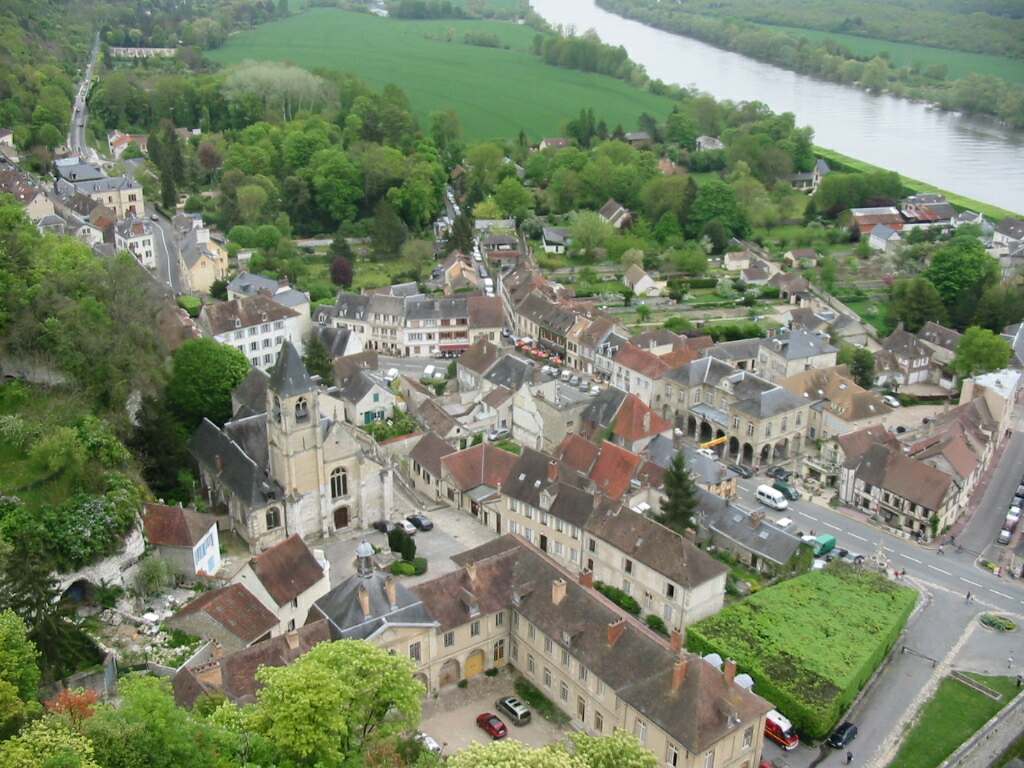

La Roche-Guyon is a village in the Val-d’Oise clinging to a chalk cliff above the Seine, in the heart of the Vexin français. Listed among Les Plus Beaux Villages de France, it combines a rock-cut château, medieval keep, historic gardens and old lanes in a particularly spectacular setting an hour from Paris.
A château literally built into the cliff
The Château de La Roche-Guyon is the heart of the visit. Its history spans almost ten centuries: the first spaces were cut into the rock, before a residential building was erected at the foot of the cliff and a keep at the top.
The keep is linked to the château by an old passage cut into the rock. This vertical arrangement is what makes the site truly unusual: you move from reception rooms to rock-cut spaces and then up to the cliff top.
Climbing to the keep
The climb to the keep requires real effort, but offers one of the area’s best panoramas over the Seine’s meanders, the village and the Vexin.
Bring good shoes and avoid treating the visit as a simple single-level château: steps, changes in height and passages cut into the rock are part of the experience.
From reception rooms to Rommel’s bunkers
The château is not limited to the Middle Ages. The state rooms, 18th-century stables and spaces linked to the duchesse d’Enville also tell the story of the Enlightenment.
In the 20th century, the site took on another dimension when Rommel established his headquarters in La Roche-Guyon during the Second World War. Bunkers and underground spaces still recall this period.
The Potager-fruitier
Opposite the château, the historic Potager-fruitier offers a pleasant extension to the visit. Restored in the spirit of the 18th-century garden, it combines fruit trees, vegetables, biodiversity and views of the château and cliff.
Activities, workshops and gatherings are offered throughout the season. In high season, some of the harvest may also be put to use on site.
A village between the Seine and rock-cut dwellings
Outside the estate, take time to explore La Roche-Guyon’s small streets. Stone houses, rock-cut dwellings and white cliffs recall how the village developed in a very constrained space between the Seine and the hillside.
The contrast between river, cliff and château gives the village a much stronger identity than a simple heritage town.
Coming without a car
La Roche-Guyon is accessible from Mantes-la-Jolie by bus route 95-11. This is an interesting option for a car-free trip from Paris, although it requires careful coordination of train and bus.
By car, a municipal car park is provided at the entrance to the village. At busy times, it is best to park as soon as a space is available rather than trying to get as close as possible to the château.
With young children
An important practical point: pushchairs are not allowed inside the château and cannot be left at the entrance. The site therefore recommends a baby carrier or another carrying system for very young children.
This restriction is worth knowing before visiting, especially as the visit includes steps and a climb to the keep.
How much time should you allow?
Allow 2 to 3 hours for a thorough visit to the château, keep and Potager-fruitier. Half a day is preferable if you also want to explore the village and Seine banks at leisure.
La Roche-Guyon combines very well with nearby Giverny, for a day mixing heritage, gardens and the Seine valley.
Visiting tips
- bring good shoes for the climb to the keep;
- with a baby, favour a carrier: pushchairs are prohibited in the château;
- use the municipal car park at the entrance to the village;
- without a car, check the connection between the train to Mantes-la-Jolie and bus 95-11;
- leave time for the Potager-fruitier and lanes, not only the château rooms;
- in hot weather, climb to the keep near the start of your visit or in the late afternoon.
La Roche-Guyon is worth the trip for this rare combination of medieval fortress, rock-cut cliff spaces, Seine and historic garden, a very short distance from densely populated Île-de-France.