Skip to content
Days out and activities near you
Sign in Sign up
Prehistory and living archaeology parks

Prehistory and living archaeology parks

26 experiences
Skip to results

Prehistory and living archaeology parks, but where?

26 spots in France.

Narrow it down to sort spots by distance

A wattle-and-daub house, a fire lit by friction or a spear thrown with a spear-thrower can transform our understanding of the past. Prehistory and living archaeology parks bring together reconstructed dwellings, traditional techniques and scheduled workshops: unlike caves or ruins, they let visitors test archaeological hypotheses.

26 spots for prehistory and living archaeology parks in France

Randa Ardesca - village gaulois reconstruit par ses artisans en Ardèche - Saint-Alban-Auriolles
Ardèche

Randa Ardesca - village gaulois reconstruit par ses artisans en Ardèche

Saint-Alban-Auriolles · near Pierrelatte

4.6 346 reviews

Know a spot?

A place missing here? Suggest it and we will check it before publishing.

What to know before booking: prehistory and living archaeology parks

Checked on

Can you always make fire or use a spear-thrower at a prehistory park?

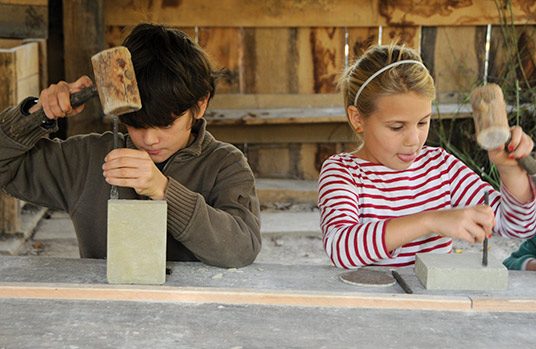
No. Flint knapping, fire lighting through percussion or friction, and throwing spears using a spear-thrower may be scheduled demonstrations or bookable workshops. A self-guided visit to an archaeological experience park does not guarantee artisans will be present: compare activity days, techniques offered and whether they are included in admission.

How does an archaeological experience park differ from a decorated cave or ruins?

An archaeological experience park features reconstructions: a Neolithic longhouse, a wattle-and-daub dwelling, a Gaulish palisade or a blacksmith's workshop. Their size and materials reflect scientific interpretations, not ancient walls surviving in place. Decorated caves and in-situ ruins are different kinds of visit; some sites include both, but with separate access.

Are living archaeology workshops suitable for young children?

Observing full-size dwellings generally has different age requirements from handling a flint tool, grease lamp or spear. Flint-knapping and spear-thrower workshops require supervision and may have specific minimum ages. Check the minimum age for each workshop, whether participants can join in and the day's timetable: there is no single national age limit.

Do children excavate real archaeological sites?

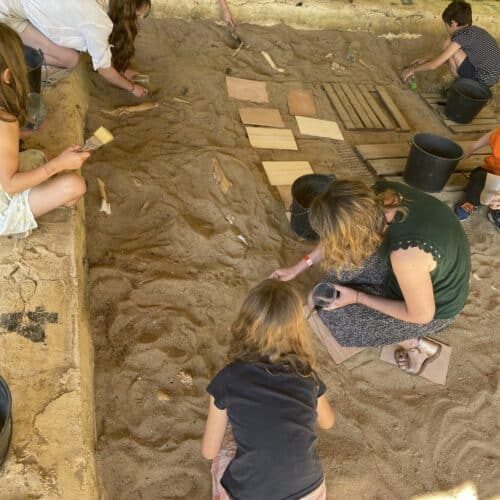
In these parks, an 'educational excavation' often uses a tray, reconstructed deposit, trowel and brush: participants learn to identify clues without disturbing protected remains. Stratigraphy is a succession of layers interpreted to date occupations. Genuine scientific excavations, overseen by organisations including Inrap, are different from these family workshops.

What exactly does 'experimental archaeology' mean?

Researchers and artisans test hypotheses by reconstructing a technique or object using resources comparable to those available in the past: pottery firing, weaving on an upright loom, timber framing or the flintworking chaîne opératoire. The goal is not to stage an unquestionably accurate history but to carry out reproducible experiments. Observations help interpret archaeological evidence.

Why do some reconstructed villages change between visits?

A murus gallicus, a raised granary or a motte-and-bailey castle may be reconstructed over successive experimental archaeology campaigns. The worksite, craftspeople and tools then become the main attraction. Elsewhere, the sets remain fixed and demonstrations only return on certain dates. Distinguish the visitor season, historic festival calendar and participatory building sessions.

Get email alerts